
Table of Contents
Disclaimer: 18+ only. Online gaming involves financial risk. We advise all users to participate responsibly, set strict personal spending limits, and only play with disposable income. The terms, conditions, and reward percentages of bonuses are subject to the final decision of the platform administrators. This is informational content, not financial advice. If gaming is affecting you negatively, please seek support.
Bingo is easy to follow once you know which version you are playing. Numbers are drawn at random, and you mark any matching numbers on your card. If you complete the required line or pattern before the other players, you win.
That is the basic idea. The details change between 90-ball and 75-ball bingo. They use different cards, different numbers, and different ways of deciding a winner.
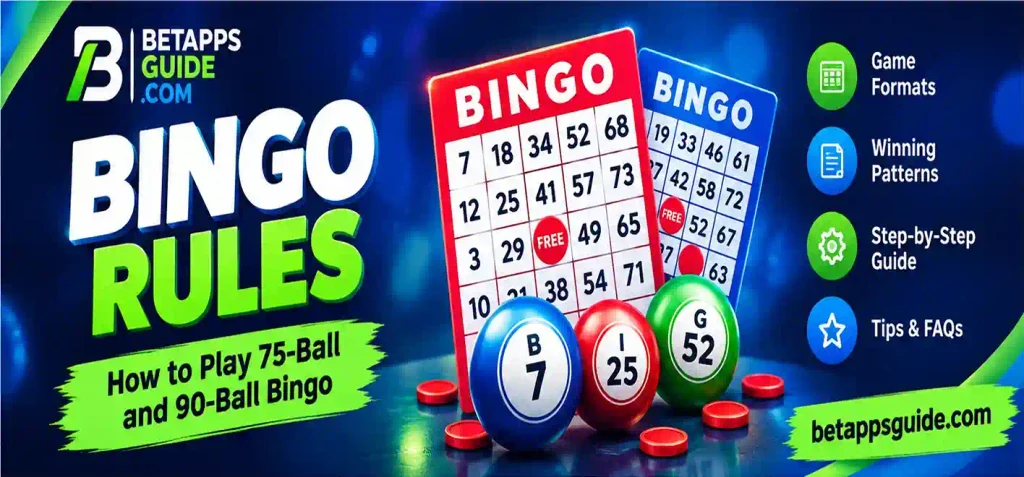
This guide explains both versions, along with online bingo and the shorter 30-ball game.
How does bingo work?
Before the game starts, each player gets one or more cards or tickets. Every card has its own selection of numbers.
A caller draws numbered balls one at a time and announces each result. If the number appears on your card, you mark it. In a bingo hall, this is usually done with an ink marker called a dauber. Online games normally mark the numbers for you.
The game continues until a player completes the stated result. This could be one line, two lines, a full house, or a shape on the card.
In a bingo hall, the player calls “Bingo” to stop the game. The caller then checks the card against the numbers already drawn. If the claim is valid, the prize is paid. Online bingo software usually detects and checks the win automatically.
Basic rules of bingo
The main rules are much the same in every version:
- Players receive or buy their bingo cards.
- Numbers are drawn at random.
- Players mark the numbers that appear on their cards.
- The first player to complete the required result claims the win.
- The card is checked before the prize is awarded.
A called number cannot be drawn again during the same game. The exact winning condition should also be made clear before play starts.
Some games have one prize. Others continue through several prize stages.
Rules of 90-ball bingo
The 90-ball game is the usual form of bingo in the UK. As its name suggests, it uses balls numbered from 1 to 90.
A standard game has three winning stages:
- One line
- Two lines
- Full house
The numbers keep coming after the one-line and two-line prizes have been claimed. The game ends when someone gets a full house.
What does a 90-ball bingo ticket look like?
A 90-ball ticket has three rows and nine columns. Each row contains five numbers and four blank spaces, giving you 15 numbers on the ticket.
The columns use set number ranges. Numbers from 1 to 9 appear in the first column. The next column contains numbers from 10 to 19, followed by 20 to 29, and so on. The last column contains numbers from 80 to 90.
Players often buy tickets in strips. A full strip contains six tickets, with all 90 numbers appearing once across the strip.
Buying a full strip means that every called number will appear somewhere on those six tickets. It does not mean that the strip is certain to win.
One line
To win the one-line prize, you must mark all five numbers in one horizontal row.
The completed row can be at the top, in the middle, or at the bottom of the ticket. The first player with a valid completed row wins that prize.
Two lines
The two-line prize requires two complete horizontal rows on the same ticket.
You cannot normally combine one completed row from one ticket with another row from a separate ticket. Both rows must belong to a single ticket.
Full house
A full house means that all 15 numbers on one ticket have been marked.
This is normally the last stage of a 90-ball game. Once a valid full house is claimed, the game is over.
How are 90-ball prizes awarded?
The prizes are usually settled in this order:
- The caller draws numbers until someone completes one line.
- The line is checked, and the prize is awarded.
- The draw continues until someone completes two lines.
- That claim is checked, and play resumes.
- The draw ends when a player completes a full house.
Individual bingo rooms may use different prize rules, so it is worth checking the game details before buying a ticket.
Rules of 75-ball bingo
The 75-ball version is common in the United States and Canada. It uses balls numbered from 1 to 75.
Players usually try to complete a pattern on a square card. The pattern is announced before the game begins. It might be a straight line, four corners, an X, or a full card.
What does a 75-ball bingo card look like?
A standard card has five rows and five columns. The columns are labelled B, I, N, G, and O.
Each column uses a separate range of numbers:
- B contains 1 to 15
- I contains 16 to 30
- N contains 31 to 45
- G contains 46 to 60
- O contains 61 to 75
The square in the middle is usually a free space. It counts as marked from the start, so the card has 24 printed numbers rather than 25.
The caller normally says both the letter and the number. A call might be “B-7” or “O-68.” The letter tells you which column to check.
Straight-line bingo
A basic 75-ball game may ask players to complete a line of five squares.
Depending on the rules, that line may run:
- Across the card
- Down the card
- Diagonally from one corner to another
The free centre square can count as part of a line.
Other bingo patterns
Many 75-ball games use shapes instead of a straight line. The pattern is shown before the first number is called.
Common patterns include four corners, an X shape, a diamond, a letter, or a frame around the outside of the card.
Only the announced pattern counts. Completing a different shape does not produce a win unless the rules include it.
Blackout or coverall
A blackout requires every numbered square on the card to be marked. This is also called a coverall.
On a standard 75-ball card, the player needs all 24 printed numbers. The free square in the centre already counts as complete.
What is the difference between 90-ball and 75-ball bingo?
The two games follow the same basic process, but the cards and winning rules are different.
A 90-ball ticket has three rows, nine columns, and 15 numbers. Prizes are usually awarded for completing one line, two lines, and a full house.
A 75-ball card has a 5-by-5 grid with a free space in the centre. Players try to complete the pattern announced for that game.
The way numbers are called also differs. In 90-ball bingo, the caller normally announces the number by itself. In 75-ball bingo, the number is usually paired with its BINGO column letter.
What happens if two players call bingo?
Two players can complete the same winning result on one called number.
If that happens, both cards are checked. When both claims are valid, the prize is often split between the winners. The exact way this is handled depends on the rules of the bingo hall or website.
How does online bingo work?
Online bingo uses digital cards instead of paper tickets, but the main rules stay the same.
You choose a game, get your cards, and wait for the draw to begin. The site displays each called number and usually marks every match automatically.
This feature is often called auto-daubing. It means you do not have to click every number yourself.
The system also checks the cards for completed lines or patterns. If one of your cards wins, the software claims it automatically. You usually do not need to press a button or type “Bingo.”
Before joining a game, check:
- Which bingo format is being used
- What result is needed to win
- How many prize stages there are
- What happens if players tie
- Whether any special house rules apply
What is live bingo?
Live bingo uses a human caller who presents the game through a video stream. Your cards remain digital, and the website still marks matching numbers automatically.
The presenter calls the numbers and announces the winners, much like a caller in a bingo hall. The exact rules depend on whether the room uses 90-ball, 75-ball, or another version of the game.
What is 30-ball bingo?
Thirty-ball bingo is a much shorter game. It is sometimes called speed bingo because it usually ends faster than the main versions.
The game uses balls numbered from 1 to 30 and a 3-by-3 card with nine numbers. There is normally one winning condition: mark every number on the card.
The first player to complete all nine squares wins.
Common bingo terms
Bingo card: The numbered grid used in 75-ball bingo and similar games.
Bingo ticket: The three-row ticket used in 90-ball bingo.
Caller: The person or computer system that announces the drawn numbers.
Dauber: The ink marker used to mark numbers on a paper card.
Free space: The centre square on a 75-ball card, which counts as marked from the beginning.
Pattern: The shape that must be completed to win a 75-ball game.
Full house: All 15 numbers marked on one 90-ball ticket.
Blackout: Every numbered square marked on a 75-ball card.
Strip: A connected set of 90-ball tickets. A full strip usually contains six tickets and covers all numbers from 1 to 90.
Is bingo a game of skill?
Bingo is a game of chance. Once the tickets have been issued, players cannot choose which numbers are drawn.
In a bingo hall, you still need to listen, mark the correct numbers, and call a win in time. Those actions help you avoid mistakes, but they do not affect the order of the draw.
Online bingo removes much of this work because the software marks the cards and checks for winners.
Having more cards gives you more entries in the same game. It also costs more and does not guarantee that one of those cards will win.
Frequently asked questions
What are the rules of bingo for beginners?
Get a card, listen to the numbers being called, and mark each match. The first player to complete the required line or pattern calls “Bingo.” The card must be checked before the win is accepted.
How do you win at bingo?
You need to complete the winning condition before the other players. In 90-ball bingo, this is usually one line, two lines, or a full house. In 75-ball bingo, you must complete the pattern announced before the game.
How many numbers are on a 90-ball ticket?
One ticket contains 15 numbers. They are arranged in three rows, with five numbers in each row.
How many tickets are in a full strip?
A full 90-ball bingo strip contains six tickets. Across those tickets, every number from 1 to 90 appears once.
Can two completed lines be on different tickets?
No. In a standard 90-ball game, both completed rows must be on the same ticket to win the two-line prize.
What is the free square in bingo?
The free square is the middle space on a standard 75-ball card. It is treated as marked before the game begins and can form part of a winning pattern.
Do online bingo players need to call “Bingo”?
Usually not. The website checks all active cards and claims valid wins automatically.
What does full house mean in bingo?
A full house in 90-ball bingo means marking all 15 numbers on one ticket.
Is a full house the same as a blackout?
They describe similar results in different versions of bingo. A full house applies to all 15 numbers on a 90-ball ticket. A blackout means completing all 24 numbered spaces on a standard 75-ball card.
A quick recap
In 90-ball bingo, players work towards one line, two lines, and then a full house. In 75-ball bingo, players complete the pattern announced at the start. Online games follow the same rules but handle the marking and checking through software.
Always read the rules shown for the individual game. Bingo rooms can change the pattern, prize stages, and tie conditions, even when they use the same number format.
Watch the original video: The Rules of Bingo – YouTube
Bet Apps Guide
Download Top Game Apps & Win Cash Daily